
Approximate Reading Time: 5 Minutes
Buying carpet isn’t just about colour or price. The best carpet is the one that suits your lifestyle, your home, and how you actually live day to day. In Australia, that means factoring in heat, kids, pets, allergies, foot traffic, and long-term value; not just what looks good in the showroom.
Australian homes experience a wide range of conditions, and many buyers are also thinking more carefully about fibre sourcing, durability, and how often a carpet may need to be replaced over time.
This carpet-buying guide is designed to help Australian homeowners and businesses make informed choices and avoid costly mistakes.
This guide explains how to buy the best carpet, drawing on clear, practical advice from Australian flooring experts who help customers make confident decisions that balance comfort, durability and long-term value every day.
Table of Contents
.jpg)
How to buy the best carpet – the short answer
To buy the best carpet, you need to:
- Choose the right fibre for your lifestyle (not just softness)
- Match pile type to traffic levels
- Understand density, twist and underlay (these could at times matter more than brand names)
- Balance upfront cost vs long-term durability
- Get professional advice and installation, not guesswork
This matters in Australia because our homes face high UV exposure, open-plan layouts, pets, kids, and the need for hard-wearing materials. A carpet that works in Europe or the US isn’t always right here.
This guide is written for homeowners and renovators, families and pet owners, budget-conscious buyers, premium and wool carpet buyers, and commercial and investment property owners.
Common carpet regrets to avoid
Many Australians don’t regret buying carpet; they regret how they bought it.
Based on real homeowner and renovator experiences, the most common carpet regrets aren’t about colour or brand. They’re about issues that only show up after installation.
Common carpet regrets include:
- Allergies or asthma symptoms are worsening after installation
- Carpet rippling or bubbling within months
- “Lifetime” warranties rejected due to fine print
- Pet smells trapped under the carpet and underlay
- Quotes increasing after stairs, prep or waste allowances
- Buying at a sale price rather than for long-term durability
Key takeaways for choosing the best carpet
- Solution-dyed nylon (SDN) offers excellent durability and stain resistance for busy households, while wool carpets are highly resilient and perform exceptionally well under long-term wear.
- Wool carpets offer comfort, insulation and luxury, at a higher cost.
- Pile density is more important than pile height for wear performance, while pile height plays a bigger role in comfort and feel underfoot.
- Underlay is not optional; it affects comfort, wear and warranty.
- Choosing purely on the lowest price can lead to higher replacement or maintenance costs over time.
- Professional advice prevents costly mistakes.
What actually makes a carpet good?
Many buying guides focus on brand names or softness. That’s misleading.
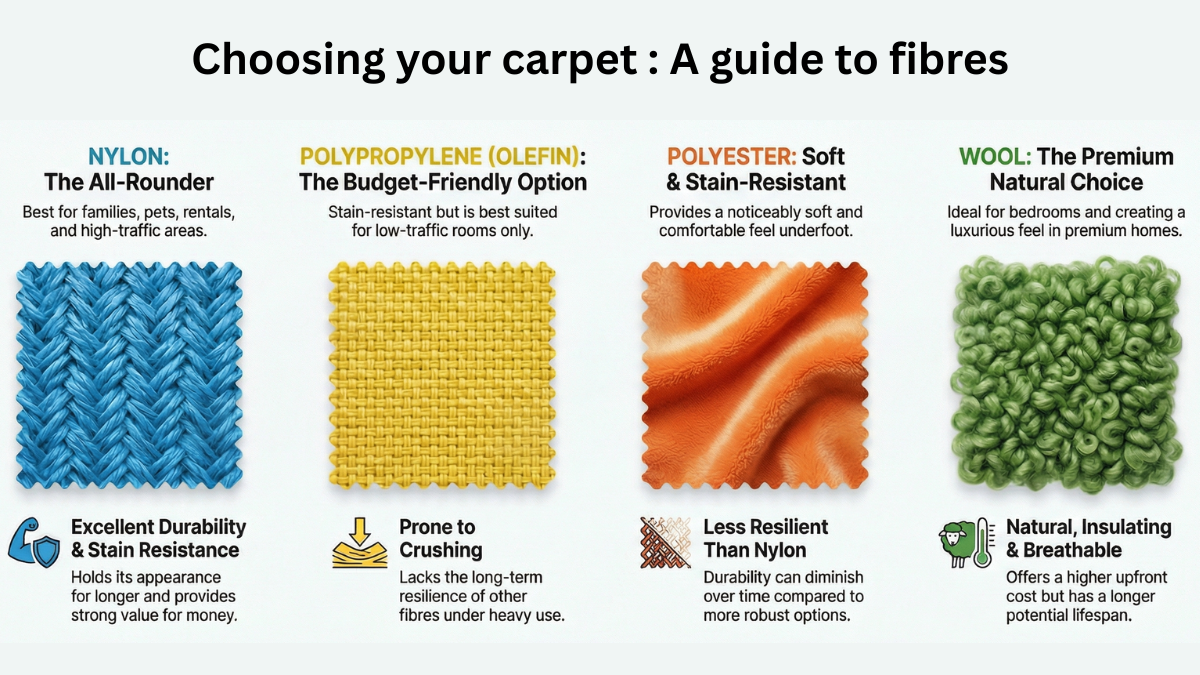
1. Carpet fibre – the most important choice
Expert tip: Fibre choice matters more than colour or brand. Always start here.
- Nylon / Solution-Dyed Nylon (SDN)
Best for families, pets, rentals, and high-traffic areas. Solution-dyed nylon (SDN) offers superior stain resistance due to colour being locked into the fibre, while nylon provides strong resilience and performance for high-traffic areas. Holds its appearance longer than cheaper fibres and offers strong value for money.
- Polypropylene (Olefin)
Budget-friendly. Stain-resistant and budget-friendly, with performance best suited to low-traffic areas depending on construction. Best for low-traffic rooms only.
- Polyester
Soft underfoot. Good stain resistance. Generally less resilient than nylon in high-traffic areas over time.
- Wool
Natural, breathable, insulating. Luxurious feel and excellent indoor air quality. Higher upfront cost, longer lifespan. Ideal for bedrooms and premium homes.
Lifestyle factors such as pets, children, and daily foot traffic often influence how well a particular carpet performs in real-world conditions.
2. Pile type and carpet construction
- Cut Pile (twist or plush):
Twist pile carpets offer better durability and footprint recovery, while plush styles provide a smoother, more luxurious appearance but show wear more readily.
- Loop Pile:
Extremely durable, hides dirt and wear well, great for hallways, stairs, and offices.
- Cut & Loop / Patterned:
Adds texture and design, hides wear better than plush styles. Popular in modern Australian homes.
3. Density, twist and face weight explained
- Density: Tighter = better durability
- Twist rate: Higher twist = fibres resist flattening
- Face weight: Useful, but meaningless without density
A dense, well-twisted mid-weight carpet often outperforms a thick, fluffy one.
Even a well-constructed carpet relies on appropriate care and ongoing maintenance to maintain its appearance and performance over time.
Allergies, dust and indoor air quality
Carpet often gets blamed for allergies, but in reality, the wrong carpet choice is usually the problem.
Is carpet bad for allergies?
Not necessarily. A well-chosen carpet can actually improve comfort and reduce airborne dust compared to hard floors — but the fibre type, pile height, and maintenance matter.
What to consider if you have allergies or asthma:
- Low-pile nylon or solution-dyed nylon (SDN) is easier to vacuum thoroughly.
- Avoid very high-pile or shag styles if symptoms are severe.
- Choose carpet labelled low-VOC to reduce chemical off-gassing.
- Ventilate the home well for the first 48–72 hours after installation.
Wool and allergies
- Wool is breathable and naturally regulates humidity.
- However, its texture can trap dust if not vacuumed regularly.
- Better suited to low-dust bedrooms than high-traffic living areas for allergy sufferers.
Practical tip:
A good HEPA-filter vacuum makes more difference to allergies than fibre choice alone.
Sustainable and eco-friendly carpet options in Australia
Sustainability matters to many Australian buyers, but “eco-friendly carpet” isn’t one-size-fits-all. Many modern carpets now use advanced fibres such as triexta and ECONYL® recycled nylon, which offer strong performance while reducing environmental impact through renewable or recycled inputs.
Common eco concerns buyers raise:
- Synthetic carpet ends up in landfills.
- Chemical use and indoor air quality.
- Short-life “fast flooring” in rentals.
Popular sustainable carpet options:
-
Wool carpets
Renewable, biodegradable, long-lasting. Higher upfront cost, Best for premium homes and long-term installs. -
Recycled nylon carpets
Made from reclaimed materials (e.g. industrial waste), Durable and practical for families and rentals. -
Natural underlays
Foam or rubber underlays, which reduce synthetic carpet content while improving comfort and insulation.
Practical tip:
The most sustainable carpet is often the one that lasts the longest in your home — replacement frequency matters as much as materials.
Pros and cons of carpet
Pros
- Warm and comfortable underfoot
- Excellent insulation and acoustics
- Safer for kids and stairs
- Wide price range and styles
- Improves comfort in Australian winters
Cons
- Requires regular vacuuming