

Reviewed by Brett Talbot, National Sales and Operations Manager, Floorworld · Last reviewed [12 October 2026]
Reviewed by Brett Talbot, National Sales and Operations Manager, Floorworld · Last reviewed [12 October 2026]
Choosing carpet for your home comes down to three decisions: the fibre, matched to how much traffic the room actually gets; the underlay, which affects comfort and lifespan as much as the carpet itself; and a realistic budget that covers supply, underlay and installation, not just the price on the swatch.
Solution-dyed nylon or triexta are the most durable carpet options for families, wool suits bedrooms and formal living areas where comfort and longevity matter more than heavy wear, and polyester works well in guest rooms and other low-traffic spaces.
It’s easy to choose carpet by colour first and durability second. Flip that order and you’ll get a better result.
A hallway, staircase or family room copes with daily footprints, dropped toys and constant traffic. A guest room or formal lounge sees a fraction of that use. Matching fibre and construction to actual traffic, rather than picking the same carpet throughout, is the single biggest factor in how good a home’s carpet still looks in five years.
It’s also worth thinking room by room rather than home-wide. Plenty of Australian households run a more durable, practical carpet through living areas and a softer, more comfort-focused option in bedrooms, and there’s nothing wrong with that split.
Fibre isn’t the only thing that affects how carpet performs, how it’s constructed matters too.
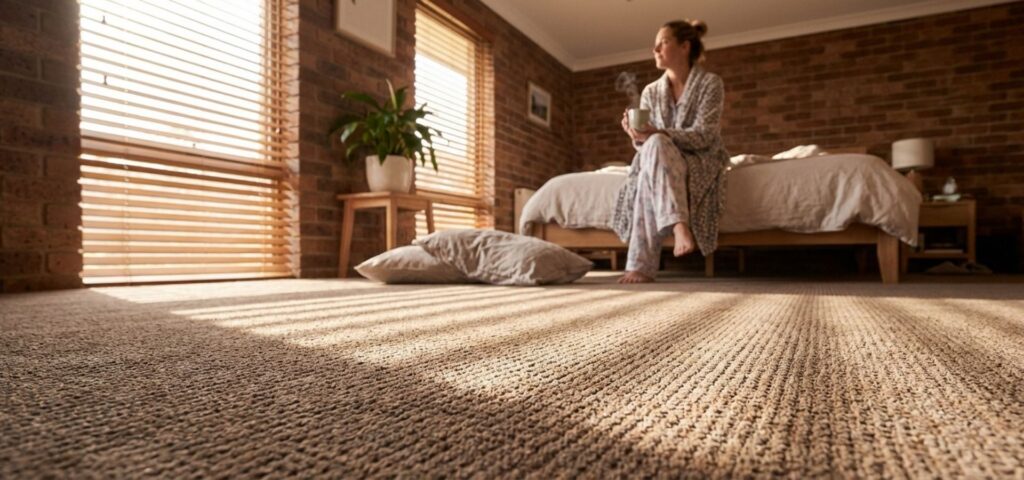
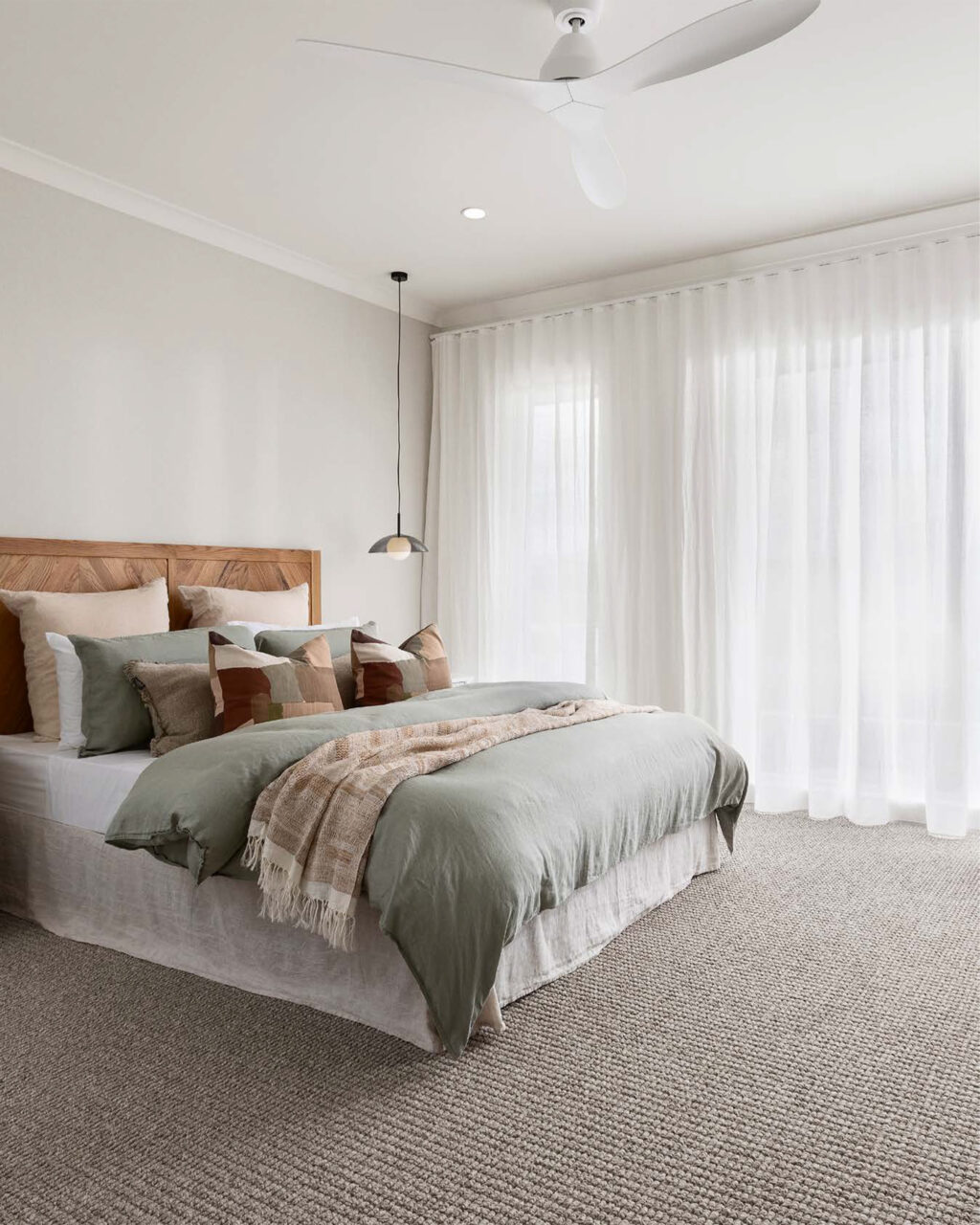
Cut pile has a soft, even surface and shows footprints and vacuum marks more readily. Loop pile is flatter and more durable, which is why you’ll often see it in commercial spaces and busy hallways. Twist pile, a cut pile with extra twist added to the fibre, is a solid middle ground for family living areas, since it hides footprints better than a plain cut pile while still holding up to regular use.
For busy households, fibre choice matters more than almost anything else.
Solution-dyed nylon is the benchmark for durable carpet for families. It resists crushing, bounces back from furniture indents, and holds its colour under sun exposure better than other synthetics. Triexta performs similarly well under heavy traffic and adds built-in stain resistance, which makes it a strong option for a home with kids or pets. Wool offers excellent long-term durability and a genuinely different feel underfoot, though it comes at a higher price and needs a little more care with spills. Polyester is the softest and most affordable option, but it flattens faster under heavy use, so it suits bedrooms and low-traffic areas better than a busy living room.
For a deeper look at how nylon and polyester actually compare, see our full fibre comparison.
Carpet cost depends on more than the fibre on the label. The range and quality within a fibre type, pile weight and density, the underlay you pair it with, and installation factors like removing old carpet or working around stairs all move the price. Two nylon carpets can sit at very different points depending on that mix, which is exactly why a single blanket figure isn’t much use to anyone.
As a general guide, Floorworld ranges are marked from $ (entry level) through to $$$$ (luxury). Polypropylene mostly sits at $ to $$, polyester at $ to $$, nylon at $$ to $$$, triexta anywhere from $ to $$$ depending on the range, and wool at $$$ to $$$$. Underlay is priced separately and follows the same logic, a basic foam costs less than an acoustic or premium option.
For exact pricing on your space, ask in-store or book a free measure and quote, and we’ll walk you through what’s driving the price in each range and where it’s worth spending more.
Every home has a different mix of rooms, traffic and budget, so the fastest way to get this right is to talk it through with someone who fits carpet every day. Find your nearest Floorworld store or book a free measure and quote to get pricing specific to your home.
What is the best carpet for a busy family home in Australia?
Solution-dyed nylon or triexta are generally the best choices for a busy family home, thanks to their durability, colour retention and stain resistance. Wool is a strong option too if budget allows and the room doesn’t see constant heavy traffic.
How much does carpet cost per square metre in Australia?
It depends on fibre, range, pile, underlay and installation requirements. Floorworld ranges are marked from $ (entry level) through to $$$$ (luxury) in-store to give you a general sense of where a range sits, and a free measure and quote gives you an exact number for your rooms.
Do I need special underlay for carpet?
Yes. Underlay affects comfort, noise and how long the carpet itself lasts, and different rooms benefit from different types, such as acoustic underlay upstairs.
What’s the difference between cut pile and loop pile carpet?
Cut pile is softer and shows less texture variation, while loop pile is flatter and more resistant to wear, which is why it’s common in high-traffic areas. Twist pile, a variation of cut pile, is a popular middle ground for family homes.
Your saved products will appear here.
Add floors you love to compare and share with your nearest Floorworld store.